Blocs du contenu principal
Social Entrepreneurship in Time of Crises
In a period of unprecedented crisis that affects the economic, political, governmental and social sectors in Lebanon, our project developed below, Social Entrepreneurship in time of crises (EC.TC), aims to improve the economic situation in Lebanon’s north, Bekaa and South region. Our teachers-trainers as well as our students, enrolled in a higher education system, will receive training and coaching services to cultivate an entrepreneurial spirit and culture. Consequently, they will share their acquired skills by engaging in community building activities among vulnerable groups.
Learning Outcomes:
-
Discover what SE is and its importance.
-
Identify the core problem they want to solve, its causes and consequences.
-
Analyze the solutions that already exist for this problem.
-
Create a value proposition and identify its core elements.
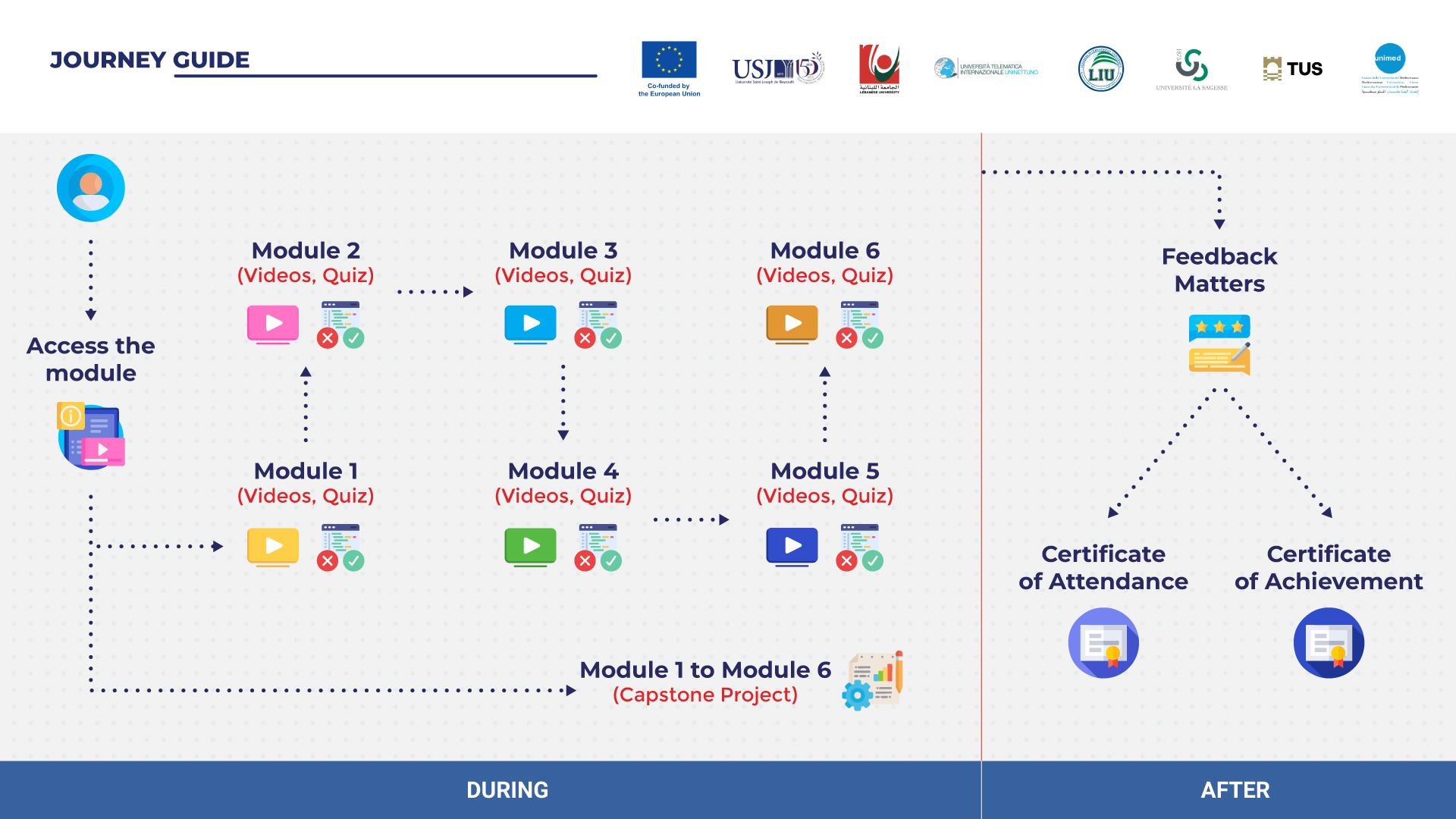
Module 1: Introduction to Social Entrepreneurship
The aim of this module is to introduce to the learner the definition of S.E., its various profiles and differences between others enterprise types, and to provide an overview of social entrepreneurship and its role in fostering social change.
- To understand the main features, the origin and the profiles of Social Enterprises.
- To identify the main elements of the Social Enterprise spectrum.
- To be aware of best practices and worst-case scenarios of Social Enterprises to face social needs.
- To become more effective in maximizing social impact rather than economic profit.
Module 2: Social impact
This module aims to introduce the learners to identification of social impact starting from the social challenges, measuring it and sharing the results. The topic of identification of social impact and design of creative solution will be applied in the topics of environmental sustainability and gender gap. Measuring social impact and communicate it is approached also on the side of community engagement.
- To introduce the learners to identification of social impact starting from the social challenges, measuring it and sharing the results.
- To apply the topics of environmental sustainability and gender gap.
Module 3: Management Marketing and Partnerships
This module aims to equip learners with the knowledge and practical skills to manage and sustain social enterprises. It explores key management and marketing strategies, introduces market research and competitive analysis, and develops learners' ability to identify, evaluate, and engage strategic partners to maximize social impact and long-term sustainability.
- To provide students with both theoretical knowledge and practical skills to navigate the world of social entrepreneurship, focusing on the management practices and strategies relevant to creating and sustaining social enterprises
- To show how social enterprises conduct market research and competitive analysis and develop a marketing strategy based on the results.
- To identify and screen potential partners.
Module 4: Digital Social Entrepreneurship
This part introduces the concept of digital social entrepreneurship, emphasizing the integration of social impact, financial sustainability, and digital technologies. It explores the role of technology in enabling access, scalability, and innovation, traces the evolution of digital social entrepreneurship, and highlights the importance of entrepreneurial ecosystems in supporting sustainable digital social ventures.
- To emphasize its dual focus on social impact and financial sustainability.
- To highlight the role of technology in driving innovation and scaling solutions.
Module 5: Financial and Economic Sustainability for Social Enterprises
This module aims to equip learners with the knowledge and skills to ensure the financial and economic sustainability of social enterprises. It explores financing options across different stages of growth, introduces key financial planning tools such as budgeting and cash flow management, and develops strategies for accessing credit and achieving long-term financial sustainability.
- To describe the various financing mechanisms for social enterprises.
- To apply financial planning tools (budgeting, break-even analysis, forecasting).
- To design sustainable revenue models.
- To analyze financial risks and sustainability strategies.
Module 6: Legal Framework and Instruments for Social Enterprises
This module introduces students to the legal frameworks governing social enterprises within the Social and Solidarity Economy (SSE). It explores how legal recognition, taxation, governance, and institutional support contribute to their sustainability and growth, while providing comparative insights from Lebanese, European, and international contexts.
- To explain the role of social enterprises and legal frameworks within the Social and Solidarity Economy (SSE).
- To analyze legal frameworks, legislative approaches, and stakeholder engagement in regulating social enterprises.
- To evaluate how taxation policies, contractual arrangements, and government support mechanisms influence the financial viability and sustainability of social enterprises, including a comparison between Lebanon and the European Union.
About the Assessment
The evaluation of the trainees will take the form of final assessment, and it will be carried out at the end of each Unit. A total of five (5) comprehension questions (true-false, multiple-choice) will correspond to each Unit. The pass rate of the interactive assessment will be 80%.